Search results for tag #slackware
![[?]](https://cdn.social.linux.pizza/system/accounts/avatars/114/418/135/965/162/614/original/90fe78a1af973214.jpg)
In the end, the sun starts shining again 🥳
This week I have 3 updates for your Slackware boxes:
- Latest updates 12-Sep-2026
- fresh-editor 0.5.1-1
- librewolf 155.0.1-1
- proton pass 140.2.-1
You can find them here:
https://codeberg.org/thesaigoneer/slackosundries
![[?]](https://snac.9space.no/thoe/s/avatar-5a0b58b269313dea9b6de3ae68307bd7.png)
Compare that to Omarchy: dot files for Arch, backed by billionaire patrons and marketed as the future of Linux, with a founder who's spent years publicly campaigning against DEI, disbanded his own company's diversity committee, cheered the end of race-conscious college admissions, and recently wrote a blog post comparing Romani people to wolves that need culling and ending with "when gypsies take over public spaces, you deport them."
If you want to put money or attention behind open source projects, consider those who are actually improving the space and not the guy with the biggest megaphone...
Here's Patrick's patreon if you feel like giving him some love: https://www.patreon.com/c/slackwarelinux/
![[?]](https://cdn.fosstodon.org/accounts/avatars/110/790/729/555/881/709/original/154f2ce4235a7a7b.jpg)
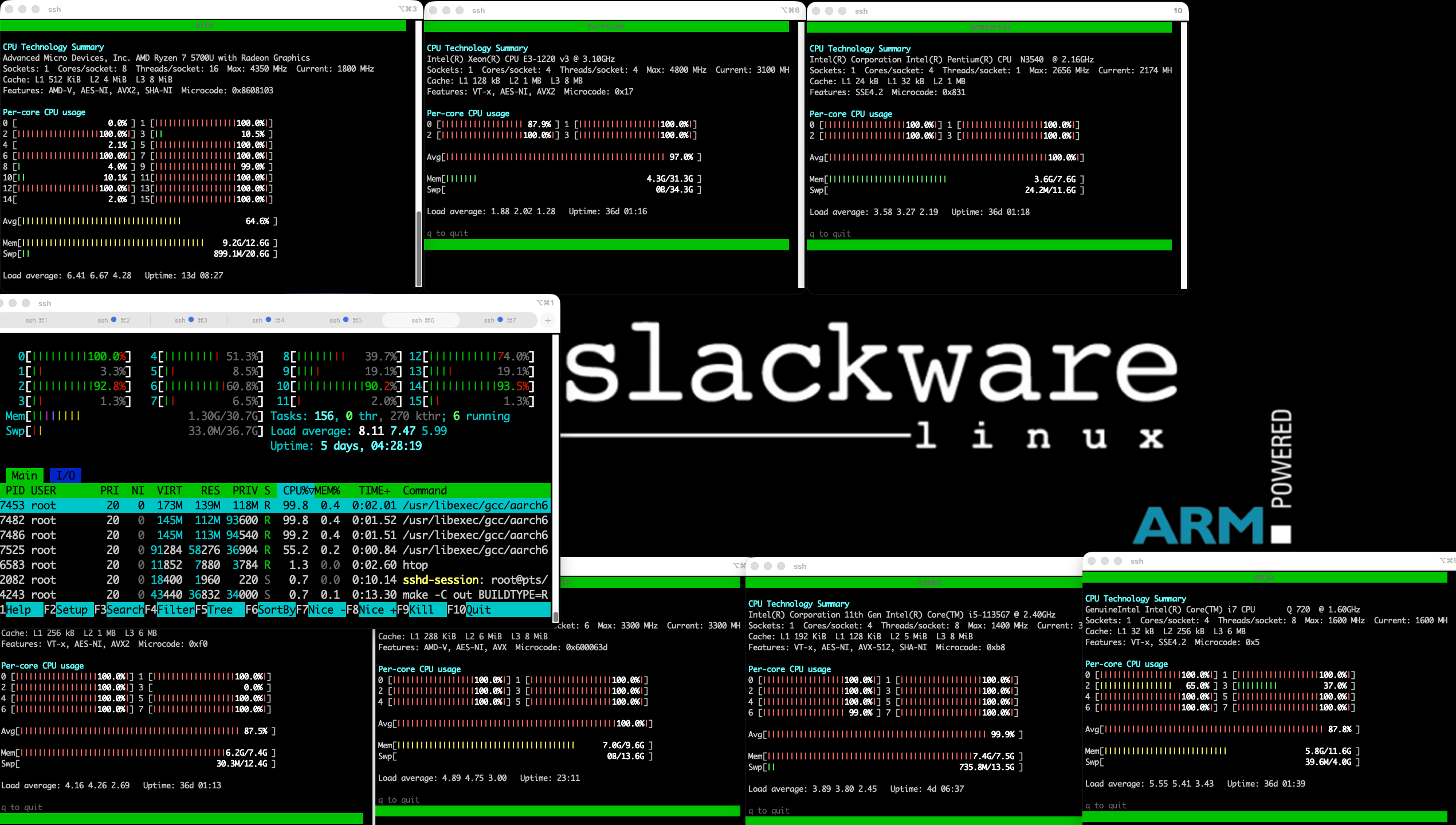
Slackware has upgraded its toolchain to GCC 16, and in preparation for the next stable release of Slackware 16.0, we’ve completed a full world rebuild.
So, how long does it take to build Slackware AArch64 with 76 cores? Let’s find out!
![[?]](https://mastodon.sdf.org/system/accounts/avatars/113/038/410/385/678/256/original/b3173e499697dd07.jpeg)
So #slackware added fwupd to current, and just like that, the Discover package in my repo for KDE lists firmware availability.
Now that's magic, folks.

Alt...
KDE Discover showing the configured repositories for updates. Showing Flathub & the Linux Vendor Firmware Service.
![[?]](https://files.mastodon.social/accounts/avatars/000/149/072/original/52bd807c44720570.png)
#Slackware New release for #slacker (x86_84, i686) https://forge.slackware.nl/rizitis/slacker/releases/tag/0.11.8_beta.4
![[?]](https://s3.digitalcourage.social/accounts/avatars/108/050/262/287/113/206/original/c152bff1a001819f.jpg)
Hi @r1w1s1,
wanted to give #slackware a try on a #ThinkPad T460 yesterday, but failed like a noob already getting the ISO to flash from https://mirrors.slackware.com/slackware/slackware-iso/. Which should I pick? Torrent preferred. Thanks!
Edit: ftp://ftp.tu-chemnitz.de/pub/linux/slackware/slackware-iso/slackware64-15.0-iso/slackware64-15.0-install-dvd.iso.txt looks promising. Should I curl that iso?
![[?]](https://snac.bsd.cafe/r1w1s1/s/avatar-aa8cf9fe6484f5e6eb3532137b7b8fee.png)
Looks old-school, but under the hood:
Slackware-current
Linux 7.2.4
glibc 2.44
cwm + XLibre
Without fetch (slackfetch), you probably wouldn't guess. :)
Wallpaper inspired by the geometric graphic design of Yusaku Kamekura.
#Slackware #cwm #X11 #unixporn

![[?]](https://public.mitra.social/media/ea33ac46ee9134f46604a8de057321fb61f6e103858bbe85145558c7986bbe9a.jpe)
16.0 Alpha 1 has arrived...
People ask me how come I often don't know these things... It's simple really. I'm on kernel-generic-7.2.4-x86_64-1 running #Slackware -current and don't actually bother to look up from the work I'm doing cause 16 is just a distro's version number, but 7.2.4 is a kernel. Officially, Slackware 16.0 Alpha is available w/the Linux huge 6.18.x kernel while 7.2.4 is in /testing.
Me, I'm just rolling along in production as I have been for close to 30 years now w/ Slackware - current looking back on the next upcoming release like it's something from yesterday lolz.
I do the same thing on #Debian (14/Testing/Forky) I just upgraded my kernel to 7.1.12+deb14-amd64 - so I'm not running that far behind the ultra-bleeding edge of Slackware, or what Arch and Gentoo users are either.
Anyway, you're going to hear more about the upcoming Slackware 16 release as the weeks go on and if there's one thing I can advise you of it's don't get caught up in the guessing game bullshit - Patrick will release it matter-of-factly w/o any fanfare and pretty much all bets will be wrong. The most you can do is to ask, "Is it soup yet?".
So here's the thread, and Patrick's response to the OP (who's running 7.3-RC1)
#tallship #FOSS #Linux #distros
⛵
Alt...
Slackware splash screen
![[?]](https://media.bsd.cafe/bsdmmedia01/accounts/avatars/114/932/322/584/208/816/original/e8177168b64868c0.jpeg)
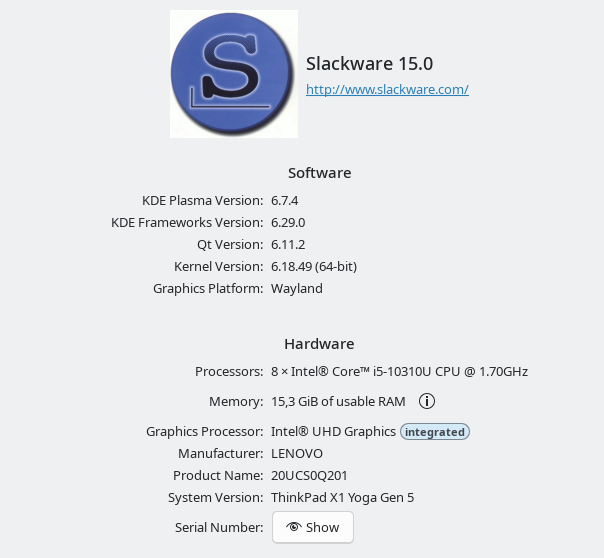
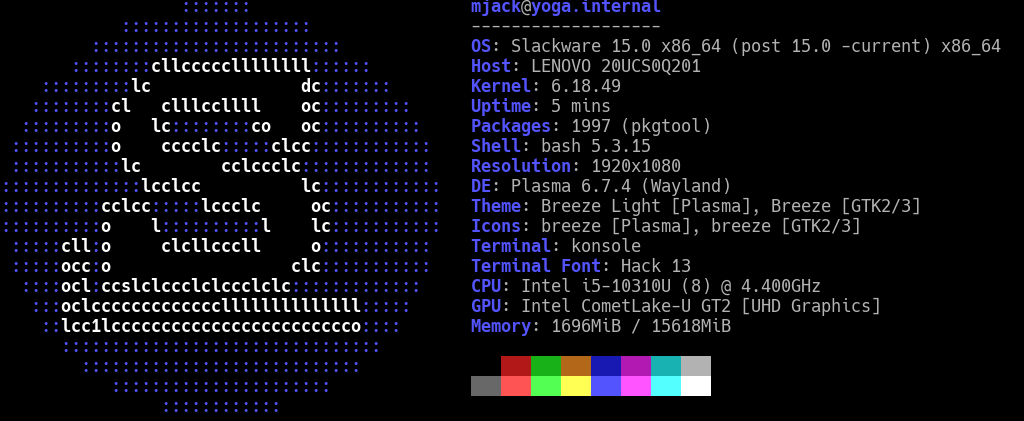
It's the first time I've installed Slackware on a laptop, I went directly to current.
With elementary OS on the other laptop, I think I can take a step back from the current #OhMyGodNotYou distro situation.
#Slackware #KDE #Plasma #Wayland
Alt...
Screen shot showing "About this System" from KDE Plasma running on Slackware 15 current
Alt...
Screen shot showing neofetch output from Slackware 15 current
![[?]](https://files.ohai.social/accounts/avatars/115/044/249/154/185/755/original/a2669ad2da29b1e9.png)
oh #slackware is almost finished awesome http://www.slackware.com/changelog/current.php?cpu=x86_64 all nice, shiny and new
You thought NixOS users were vocal? Listen to the Slackers chirping away, with version 16 presumably on the horizon 🤣
Let's check the mirrors and join in 🥳
#slackware
so why I still/again use #slackware is the excellent base collection of packages, the recent versions, no systemd and it's design focused on leaving every piece of software "as is", super simple packaging I can easily add, absolutely ZERO fluff added, absolutely super stable, you can still understand the whole system, no snapflataptpackyum and almost "complete" for my personal taste.
I usually just add some of my fancy CLI tools I like and the container bla and I'm done.
![[?]](https://gts.tumfatig.net/fileserver/01FJ093H6Y5VGN20G998J7KN1M/attachment/original/01JZTJV1P9RVJ502PCXKN68R1F.jpeg)
One of the main problem with #Slackware #Linux is that it is rock solid. Why is this a problem? Because I never feel like doing updates!
If it ain’t broken, don’t fix it.
![[?]](https://mediacdn.aus.social/accounts/avatars/112/235/224/277/576/686/original/29dfa5ea22873ad6.jpg)
If the direction of Audacity bothers you on #Slackware then try my Tenacity Slackbuild.
The entire distribution was rebuilt with GCC 16.2.0, glibc 2.44 and binutils 2.47.
Patrick Volkerding:
"Fine, it's 16.0 alpha 1."
Time to upgrade.
Not my first #Linux material but the oldest I could find that survived my several movings.
#Slackware CD from 1995. I had no Internet access at that time. Just the provided binaries, sources and documentation.
EDIT: I found an online archive 😍 https://www.abandonware-magazines.org/affiche_mag.php?mag=109&num=8503&album=oui

Alt...
A photo collage showing to sides of a CD-ROM and its cover. Content of the CD is listed. In all those, one can see a Slackware Linux reference.
And the best part? A Winamp mini player with support for classic .wsz skins. I absolutely love this idea.
Modern Spotify, old-school Winamp.
I already made a SlackBuild for it, waiting for approval. :)
![[?]](https://mastodon.sdf.org/system/accounts/avatars/000/005/463/original/a54b1acc2e3ae4b1.jpg)
Funnily enough, I was never really into #Debian ... I appreciate the quality of the distro, but... I don't know, too many moving parts, I guess.
I will continue supporting #Slackware I'll look into #Guix and, of course, #OpenBSD and #NetBSD as well as #HardenedBSD .
The line is drawn. It is time to choose your side.
I remember there was a kind of #Slackware vs #Debian distro war when I was young(er) (hear late 90s). Not to brag but… I was always a Slacker 😬
Yes, I'm an MS Office 2013 refugee.
Thus: loving the new LibreOffice 26.8 tabbed interface!

Alt...
Scrot of the tabbed user interface of LibreOffice 26.8. Very MS Office- like, which I grew up with. Great!
As busy as last week was, as quiet has it become right now 😆
Only Librewolf gets an update and you'll find it here:
#slackware #slackosundries
https://codeberg.org/thesaigoneer/slackosundries
Oh, BTW, it actually works pretty well to (un)plug #ZFS single-stripe disks from #FreeBSD 14 to #Slackware 15.0 to #FreeBSD 15.1 and still be able to access the data in the end.
yes, some zfs export and zfs import (-f) are useful
nope, you don’t want to bother why this happened.
I'd also promised some #umbriel packages for #noctalia on #slackware and it's all very messy because nothing has a stable release yet but I did put up packages for x86_64. I could have organized it a bit but, well, it's my mess, I'll clean it when I feel like it ;)
https://slackware.lngn.net/pub/testing/umbriel/
P.S. - don't use the "start-umbriel" script as it's for systemd, and upgradepkg "scenefx" if you have the package installed already from my repo.
After my blurb y'day of enjoying it on Kalpa, I liked it even better to see that AlienBob has Ungoogled Chromium in his repo, great stuff! Also, slackbuilds for Brave-Origin, Librewolf and Bottom are available (not by me) and up to date, so my SlackoSundries will get a big overhaul by September 1st.
#slackware #slackosundries
Option "DontZap" "True" prevents Ctrl+Alt+Backspace from
terminating X.
Option "DontVTSwitch" "True" prevents switching to another virtual
terminal, but removes an important recovery path.
For most personal systems, DontZap alone is the balanced choice.
DontVTSwitch may make sense for kiosks or systems with stricter
physical-access requirements.
More details:
https://raw.githubusercontent.com/r1w1s1/code-notes/refs/heads/master/notes/X11_ServerFlags.txt
Goodies come early today. Whilst some of you are stil TGIF'in, the sundries have arrived on our Saturday morning.
This week brings 6 updates for our Slackware boxes: bottom, brave-origin, fresh-editor, librewolf, proton-pass and vivaldi-stable.
EDIT: And we have one new entry this week, the musicplayer Harmonoid.
You can find them all here:
https://codeberg.org/thesaigoneer/slackosundries
#slackware #bottom #brave #fresh-editor #librewolf #proton #vivaldi #harmonoid
With me, finally, working out window rules in the new hyprland.lua config and replacing dank with noctalia, hyprland is growing on me again. Next up will be testing the overview and scrolling layout. And a config push to the Bergies 🤓
Find them here:https://codeberg.org/thesaigoneer/slackware-tilers
#slackware #hyprland
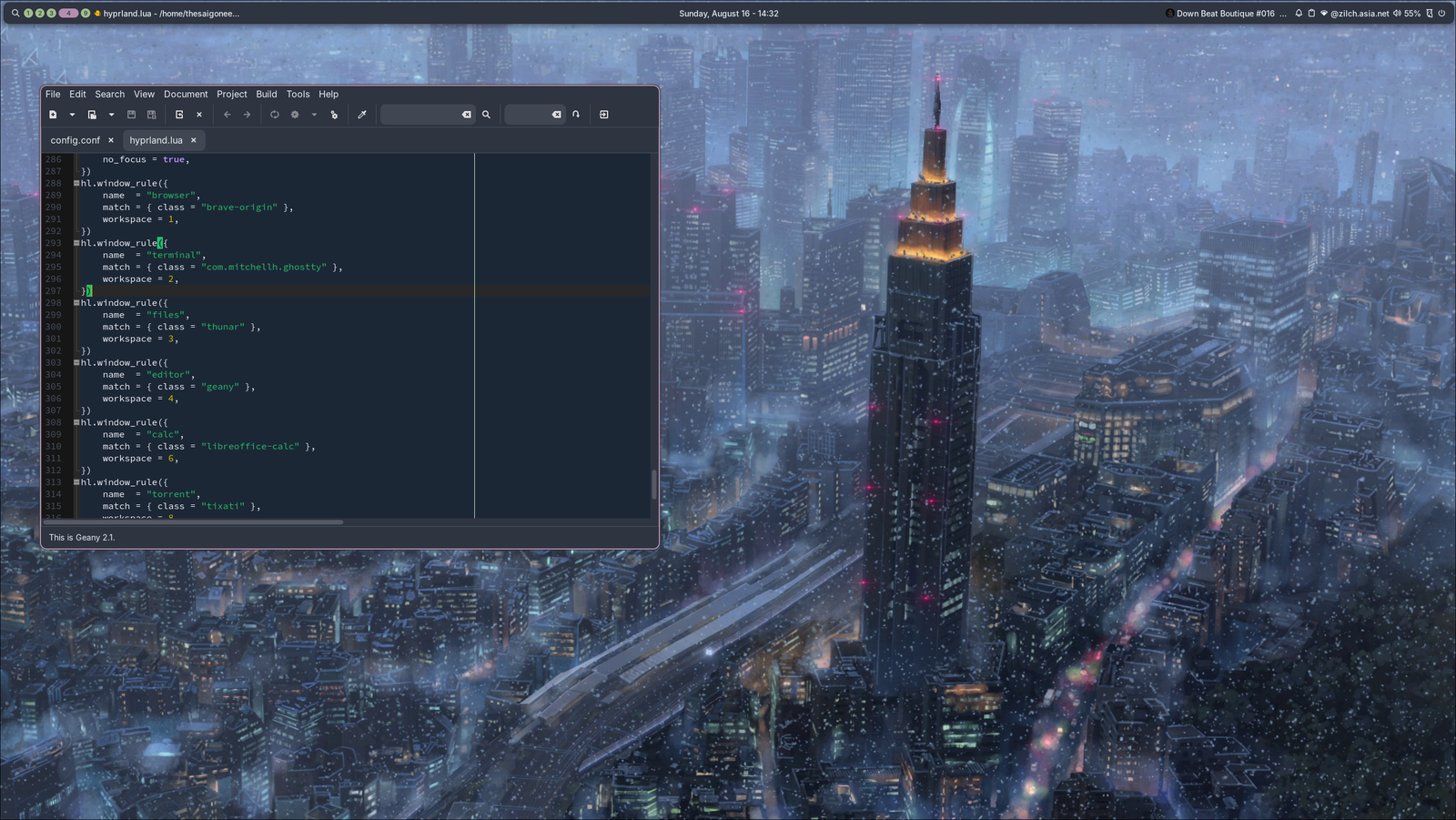
Alt...
Scrot of a Geany window on Slackware Current & Hyprland, with Noctalia shell, defining some application window rules
I'm also preparing a SlackBuild for SlackBuilds.org, hopefully available next week.
#slackware #font #uwttyp0 #slackfetch
the package :) works -current and 15
https://slackbuilds.org/repository/15.0/system/fonts-uw-ttyp0/

Yep. Slackware is outdated. Or is it?
Hyprland 0.56.2, Ghostty, Fresh editor, DankMaterialShell and Zen browser. Enuff said.
#slackware #hyprland
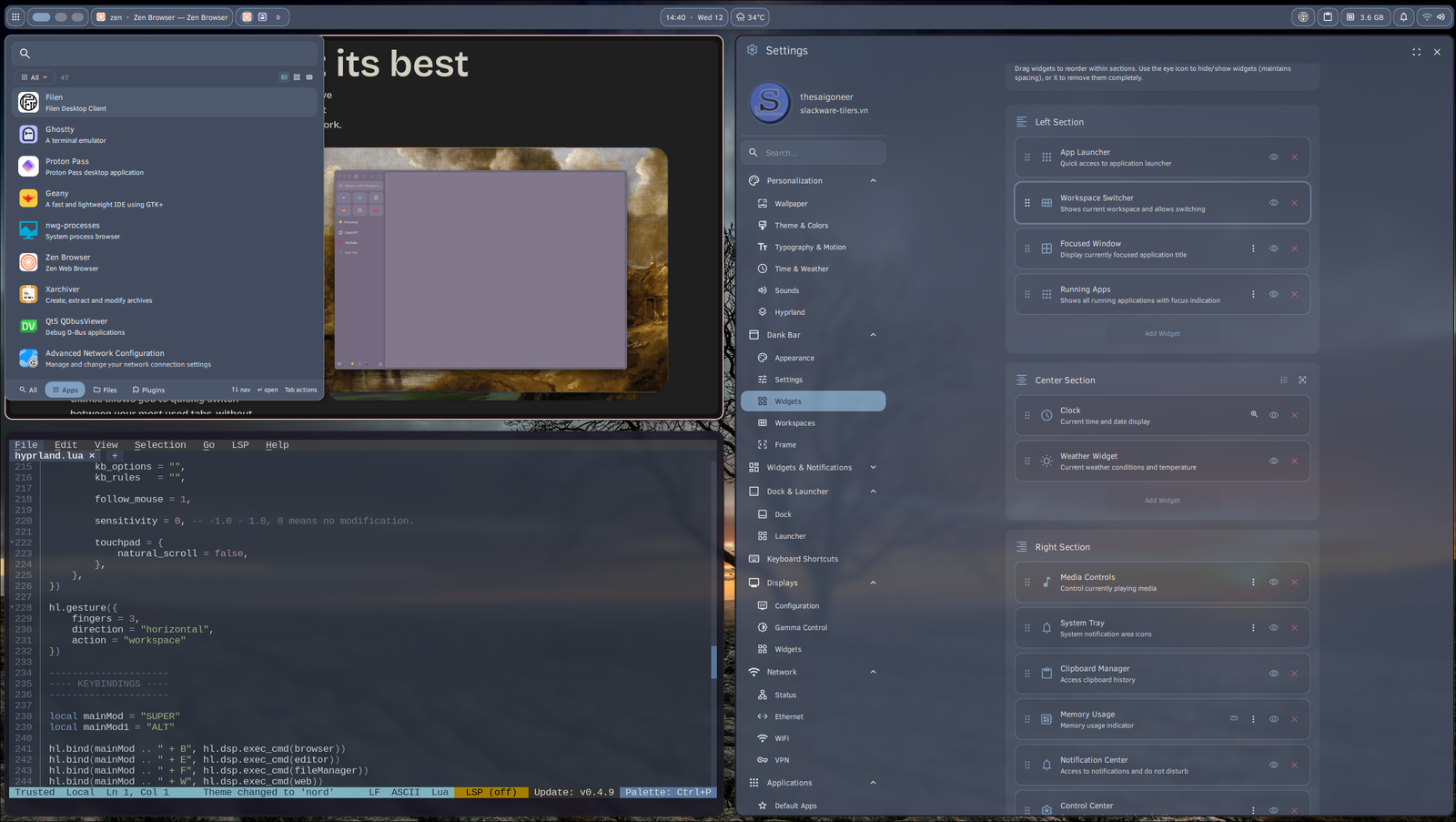
Alt...
Scrot of Hyprland 0.56.2, Ghostty, Fresh editor, DankMaterialShell and Zen browser on Slackware Current
Slacker 0.11.4 is out for testers.
#Slackware
https://forge.slackware.nl/rizitis/slacker/releases
Finally updated slackfetch @r1w1s1 😊
#slackware #kde
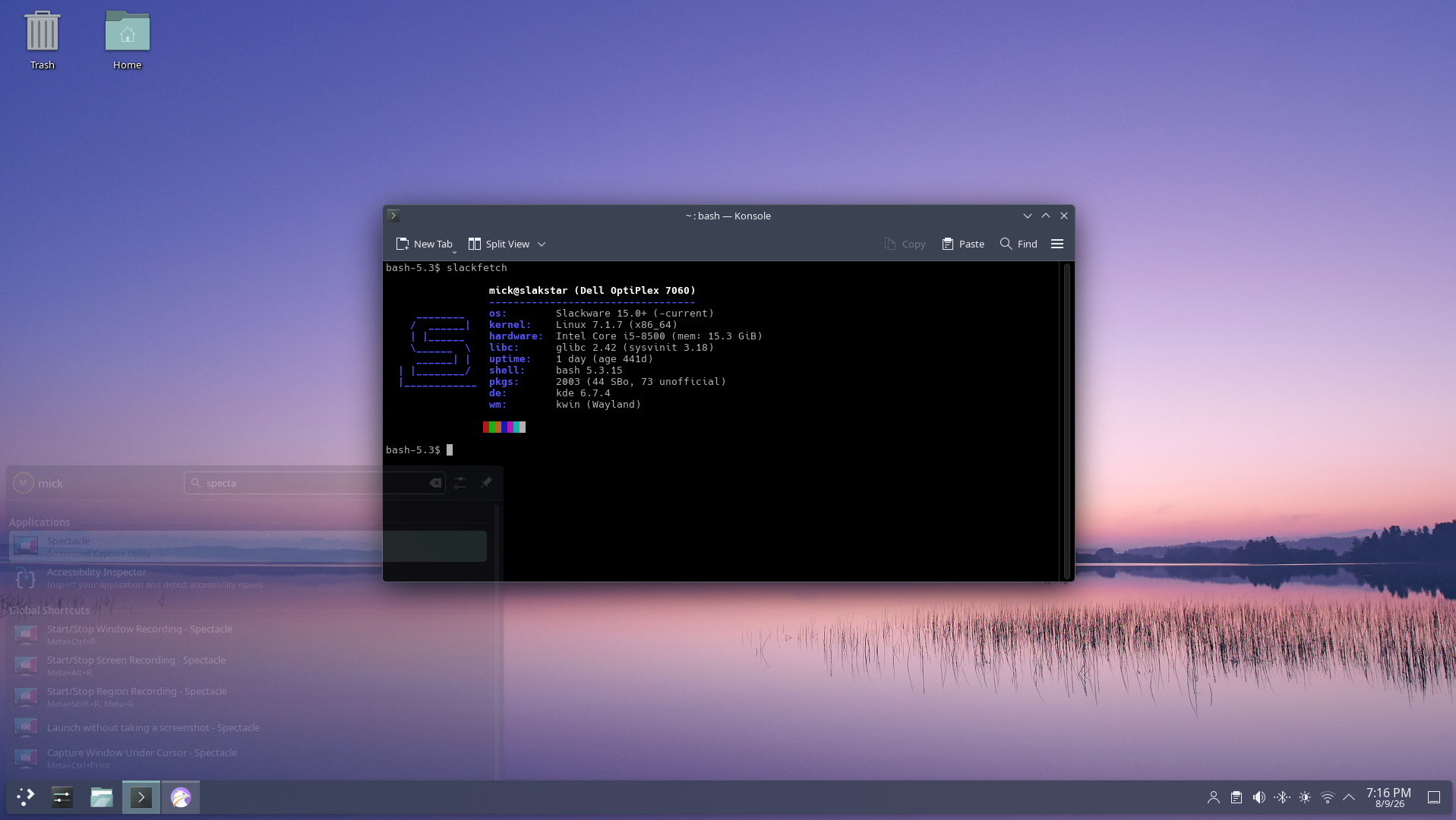
Alt...
Screenshot of KDE with slackfetch running in konsole
It includes installation instructions, SlackBuilds, package status, and project documentation.
If you're interested in trying SonicDE on Slackware, have a look:
https://sonicde-slackware.github.io/
Feedback, testing, and contributions are always appreciated.
Slackosundries freshly baked!
A lot of updates this week and ProtonPass as a new addition!
Go get them for your Slackware install as long as supplies last 😎
- Updates 01-Aug-2026
- bottom 0.14.7-1
- brave-origin 1.93.129-1
- filen 3.0.53
- fresh-editor 0.4.6-1
- librewolf 153.0.1-1
- proton pass 1.38.1-1
- vivaldi 8.1.4087.61-1
#slackware #slackosundries
https://codeberg.org/thesaigoneer/slackosundries